


The Price of Our Appetite. Food Systems, Industrial Animal Farming, and the Price of Our Consumption

“Almost 95 billion farmed animals.”
This number was mentioned by The Guardian as part of its current reporting on the global increase in livestock farming. The scale of this number is difficult to comprehend, yet it is a reality. The article refers to figures from a report published in June 2026 by the Stop Financing Factory Farming Coalition, according to which around 94.9 billion land animals worldwide were kept or used for the production of meat, milk, and eggs in 2023, compared with 61.8 billion in 2006. This represents an increase of more than 50% in the number of mammals and poultry kept worldwide since 2006, as well as an increase of around 25% in the amount of cropland used to grow animal feed. The consequences extend far beyond agriculture: land, water, biodiversity, and ecosystems are increasingly under pressure. Global livestock farming is a significant driver of greenhouse gas emissions. According to FAO calculations, global livestock and related agrifood systems produced around 6.2 billion tons of CO₂-equivalent emissions in 2015, approximately 12% of human-caused greenhouse gas emissions. And yet we rarely think about our food in this way. We see a steak, a chicken breast, a glass of milk, or an egg. We see a product, but we do not see the animal, the sentient being, behind it. We also do not see the land required to feed it, the water consumed in doing so, the ecosystems altered for its production, or the species that may lose their habitats as a result. And hardly anyone asks one of the most uncomfortable questions of all: What kind of world have we created in order to eat the way we do today?
When Food Becomes an Industry
Humans began eating animals in prehistoric times - this is historically and anthropologically undeniable. We humans are omnivores by nature, with remarkable dietary flexibility. Our anatomy, from our jaws to our digestive system, enables us to process both plant-based and animal-based foods. Throughout our evolution, our diet was highly flexible and shaped to a significant extent by geographical and climatic availability. However, this does not automatically mean that every form or every level of today's meat consumption is biologically necessary. For the vast majority of human history, animal products were very limited resources. Obtaining meat required considerable time, effort, and resources, as it was not available everywhere and at all times in unlimited quantities. But something fundamental has changed.
Today, we have transformed animal products into a global mass industry. What was once limited is now available in abundance. What was once valuable has become cheap. What was once directly connected to a living animal has become a commodity. The question, therefore, is not simply whether people should eat meat. The deeper, ethically charged question must be:
What happens when our natural relationship with animals and food is replaced by industrial-scale production and mass consumption?
The Invisible Price of Our Appetite
The price we pay at the supermarket does not reflect the true overall costs of what we eat. It does not show the land on which animal feed is grown. It does not show the water required for it. It does not show the methane and other greenhouse gas emissions. It does not show the pollution of rivers and soils. It does not show the forests and habitats that are lost. And it certainly does not show the immense suffering of billions (!) of animals behind the product.
There are also massive ecological consequences, as industrial animal farming is closely linked to excessive land use, greenhouse gas emissions, water consumption, pollution, and biodiversity loss. The expansion of agricultural land for livestock farming and animal feed production contributes to habitat destruction and places additional pressure on ecosystems that are already struggling with the consequences of climate change.
The paradoxical result: Humans have created an extraordinarily powerful system for producing food. Yet the more we expand it, the greater the pressure becomes on precisely those natural systems that make food production possible in the first place. In one sentence: We are effectively consuming the foundations of our own survival.
The Tragedy of Abundance
Perhaps the greatest irony is that our problem is not scarcity. Our ancestors had to search for food with great effort. For us, it is abundance. We must learn when enough is enough. The human brain evolved in an environment in which energy-dense food was valuable and often difficult to obtain. Today, at least in affluent societies, we live in a completely different reality: a world in which food is constantly available. The result is a profound discrepancy. Our biological needs have not changed at the same pace as our economic systems. Today we live in a world where animal products can be consumed daily and in large quantities, and are often even thrown away unused. For most of human history, this would have been unimaginable. We, on the other hand, have built an economy designed to maintain this abundance. But abundance is not automatically progress. This abundance simply means that we have become highly efficient at consuming too much.
The Question of Our Health
This raises another uncomfortable question. Are we actually eating in a way that serves our health? Humans can digest animal products; that is a biological fact. But the modern Western diet does not simply consist of occasionally consuming meat or dairy products. It is about the amount, the frequency, and the industrial processing of what we consume. Our bodies are now confronted with living environments that differ fundamentally from the nutritional environments of our ancestors. Biologically, our bodies could not adapt to this historically rapid change at the same pace. The problem, therefore, is not eating animal products at all. The problem lies in the fact that we have transformed animal products – together with other highly processed foods – into an everyday industrial abundance. In many affluent societies, this abundance goes hand in hand with excessive energy intake and increasingly sedentary lifestyles. The same system that produces more food today than ever before does not therefore necessarily produce healthier people. That should make us think.
If a food system damages ecosystems, causes immense animal suffering, and can simultaneously contribute to health problems – can we really call it successful simply because it produces large quantities at comparatively low prices?
The Animals We No Longer See
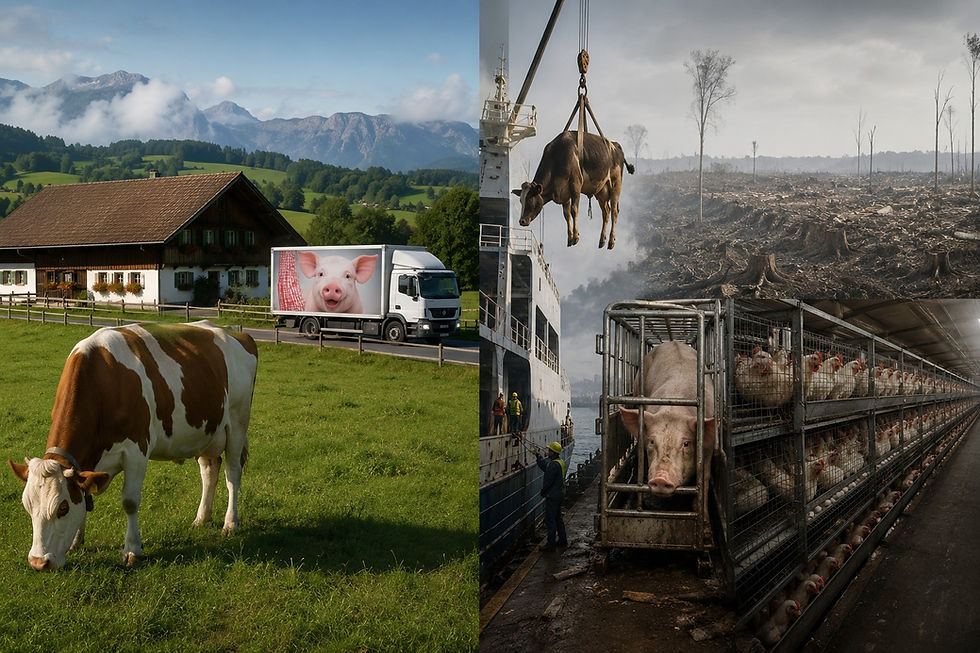
Perhaps one of the most disturbing aspects of modern food production is how successfully it has separated consumers from the living beings behind the products. We can love animals and care deeply about our dogs and cats. We can be horrified by cruelty – and yet still be part of a system that causes immense suffering without ever directly confronting it or wanting to know about it. The supermarket makes this possible. The animal disappears. The product remains. This distance is psychologically powerful. It allows us to separate the meal from the life that preceded it. Images of happy cows grazing in pastures on the milk carton, smiling pigs on the advertising poster. But the sentient, real animal has not disappeared; it has merely been removed from our field of vision. This raises another fundamental ethical question:
If we acknowledge that animals can experience pain, fear, and suffering – what responsibility do we have towards them?And perhaps an even more difficult one:Does our ability to consume something automatically justify our right to do so?
The Ecological Costs Extend Beyond Animal Farming
The story does not end with meat. Modern food systems are also linked to intensive crop production, monocultures, pesticide use, soil degradation, and water pollution. We have simplified complex ecosystems in order to maximize production. But nature is not a factory. A healthy ecosystem depends on diversity and interdependence. Pollinators, soil organisms, plants, insects, birds, wildlife, water systems. Every species exists within relationships that we often do not yet fully understand. When habitats disappear, we do not simply lose individual animals or plants. We weaken the systems that sustain life on Earth. And this is precisely where the question of our food becomes something much greater than the question of what we personally want to eat. It becomes a question about the future of the living world.
Why Do We Keep Going?
Perhaps this is the most important question of all. We know what is happening. We know about climate change. We know about biodiversity loss. We know about environmental destruction. We know about the suffering associated with industrial animal production. Why, then, do we continue to expand this system? The answer cannot simply be that individual people are selfish or ignorant. The system itself creates powerful economic incentives.
Global agriculture, food production, and livestock farming are tied to enormous financial interests. Companies are expected to grow, investors expect returns, markets reward efficiency and scale, and consumers expect low prices and constant availability. Farmers depend on existing production systems, employees depend on jobs, and entire regions depend economically on agriculture. We created all of this. The result is a system in which almost everyone is part of a structure that individuals can hardly change on their own. And that is precisely why it is too simplistic to place the responsibility on consumers.
The question is not only: “Why don't people simply change what they eat?”The question is: “Why did we create an economic system in which acting ethically can appear economically irrational?”
Change Without Losers
If we want to transform our food system, we must take this reality seriously. We cannot simply tell farmers to stop keeping animals. We cannot tell workers that their industries are outdated. We cannot expect entire regions to give up the economic foundations on which they depend. A transformation that creates only losers will fail. The real challenge is to create new pathways. Farmers could be supported in transitioning to regenerative agriculture, more diverse forms of production, or alternative crops. Companies could be encouraged to develop new products and business models. Investment could flow into more sustainable alternative protein sources and food systems. Agricultural policies could reward ecological responsibility rather than simply maximizing production. And consumers could be given genuine alternatives that are affordable, accessible, and truly sustainable. The question should not be: Who has to lose for the system to change?But rather: How can we redirect economic power so that people no longer have to choose between their livelihoods and a healthier planet?
This may be the greatest economic challenge of this transformation. The goal should not be to destroy industries. It should be to transform them, as quickly as possible. Anything else seems utopian and divides humanity more than it unites us. Human creativity, investment, and entrepreneurship must be directed toward systems that do not depend on the limitless exploitation of animals and nature.
The Boundary We Are Approaching
We often talk about climate change as if it were a single crisis. It is not. Climate, biodiversity, water, soils, ecosystems, and food security are deeply interconnected. When one of these systems is weakened, the others also come under pressure. And the closer we come to the limits of these systems, the more vulnerable our own future becomes. We do not stand outside nature and decide how much of it we want to preserve. We are part of it; we depend on the same water systems, the same soils, the same biodiversity, the same atmosphere, the same ecological networks. We are not destroying an environment that belongs to someone else. We are damaging the conditions that make our own existence possible. Perhaps that is the greatest tragedy. We have become powerful enough to change the planet - but perhaps not yet wise enough to fully understand the consequences of that power.
The Question Behind the Question
The debate about food is often reduced to: meat or no meat. Animal products or no animal products, as an individual choice. But it is about far more than what we choose to put on our plates.
What kind of relationship do we, as humanity, want to have with the living world?
What are we willing to destroy in order to eat what we want to eat?
Why do we, as a society, accept that we inflict so much suffering on other living beings when we do not have to?
Can we create an economy in which the protection of animals, the preservation of nature, and human well-being are no longer competing goals, but the foundation of the same system?
The answer lies not only in our economic systems. It also lies in our ability to suppress suffering when doing so serves our own comfort. We know that there is a living being behind the product. We know that production has ecological consequences. We know that our consumption is not without alternatives. And yet we continue. Not because we have no choice. But because the consequences of our actions have become invisible to us. Perhaps the real challenge, therefore, is not only to transform our food system. The future of our food will not be decided by a single consumer, a single farmer, or a single company. It will depend on whether we are willing to rethink the systems that connect them all. Perhaps we need to rethink our relationship with life itself. For a civilization demonstrates its moral maturity not only through how it treats its most vulnerable people, but also through how it treats the living beings and nature over which it holds power. In the end, the question is therefore not only what lies on our plates. The question is who we want to be when we have the power to act differently.
We would like to invite to continue to these thoughts.
Where do the greatest causes of the problem lie?
What changes are truly necessary? And above all:
How can we transform existing systems so that people, animals, and nature are no longer played against one another?
Thoughtful, respectful, and constructive comments are very welcome. Because in the long term, Eticania.org should be more than a place where we write about the great challenges of our time. With the Eticania Creative Campus, we want to create a space where people can think together, discuss, and develop concrete ideas, and where everyone can contribute their own thoughts, perspectives, and proposed solutions to help shape our shared future for the better. Change begins exactly there: with a thought that someone speaks aloud - and with others who continue to think it through.
References
Food and Agriculture Organization of the United Nations. (2006). Livestock's long shadow: Environmental issues and options. FAO. https://www.fao.org/4/a0701e/a0701e00.htm
Food and Agriculture Organization of the United Nations. (2023). Pathways towards lower emissions: A global assessment of the greenhouse gas emissions and mitigation options from livestock agrifood systems. FAO. https://doi.org/10.4060/cc9029en
Poore, J., & Nemecek, T. (2018). Reducing food's environmental impacts through producers and consumers. Science, 360(6392), 987–992. https://doi.org/10.1126/science.aaq0216
Schrobback, P., Dennis, G., Li, Y., Mayberry, D., Shaw, A., Knight-Jones, T., Marsh, T. L., Pendell, D. L., Torgerson, P. R., Gilbert, W., Huntington, B., Raymond, K., Stacey, D. A., Bernardo, T., Bruce, M., McIntyre, K. M., Rushton, J., & Herrero, M. (2023). Approximating the global economic (market) value of farmed animals. Global Food Security, 39, 100722. https://doi.org/10.1016/j.gfs.2023.100722
Stop Financing Factory Farming. (2026, June 24). Livestock's lengthening shadow: 20 years after the FAO report. https://stopfinancingfactoryfarming.com/publications/livestocks-lengthening-shadow
The Guardian. (2026, July 2). Global boom in livestock farming since 2006 is piling pressure on nature, report finds. https://www.theguardian.com/environment/2026/jul/02/huge-rise-mammals-poultry-livestock-farming-worldwide-nature-report
Willett, W., Rockström, J., Loken, B., Springmann, M., Lang, T., Vermeulen, S., Garnett, T., Tilman, D., DeClerck, F., Wood, A., Jonell, M., Clark, M., Gordon, L. J., Fanzo, J., Hawkes, C., Zurayk, R., Rivera, J. A., De Vries, W., Majele Sibanda, L., ... Murray, C. J. L. (2019). Food in the Anthropocene: The EAT–Lancet Commission on healthy diets from sustainable food systems. The Lancet, 393(10170), 447–492. https://doi.org/10.1016/S0140-6736(18)31788-4


Comments